Revix vs CodeRabbit: which AI code review tool fits your team?
Revix vs CodeRabbit for AI code review: Git hosts, price, how each reviews, and where CodeRabbit fits better. Prices checked November 2026. By Revix.

CodeRabbit covers more Git hosts and also reviews in your IDE and CLI. Revix builds review rules from your own repo and links the rule in each comment, on GitHub.com, GitLab.com, and Bitbucket Cloud. Pick by Git host first, then by how you want rules to work.
We build Revix. We checked CodeRabbit on its own pricing page and docs on November 26, 2026.
Want to see Revix on your own pull requests? Start a 14-day trial, no credit card.
Side by side
| CodeRabbit | Revix | |
|---|---|---|
| Git hosts | GitHub.com, GitHub Enterprise Server, GitLab.com, GitLab self-managed, Bitbucket Cloud, Bitbucket Data Center, Azure DevOps | GitHub.com, GitLab.com, Bitbucket Cloud |
| Where it reviews | Pull requests, CLI, IDE, agent loops | Pull requests only |
| Paid start price | 24 USD per user per month annual (30 monthly) | 20 EUR per seat per month annual (25 monthly) |
| Free plan | PR summaries only. Reviews through the VS Code extension and CLI | Open Source plan: free reviews for public repositories |
| Open source | Public repos get Team features free | Free for public repositories |
| Trial | 14-day Advanced trial | 14 days on every plan, no credit card |
| Hourly review limits | 5 / 8 / 10 / 12 per developer (Essentials / Team / Advanced / Enterprise) | No hourly limit published. Pro has nearly 3x Starter usage |
| Rules and context | Guideline files, plus what it learns from your feedback | Rules built from your repo, updated after merges, editable |
| Integrations | Jira and Linear | Jira and Slack on Starter and Pro. Linear and ClickUp context on Starter and Pro |
| Self-hosting | Enterprise, 500+ seats | Not available |
| Certifications | Not checked by us | SOC 2 Type II and ISO 27001 certified (Enterprise) |
Checked November 26, 2026. Prices are in different currencies and plans differ.
See how Revix reviews your code: try it free for 14 days.
Two test PRs
These are two small public test PRs, not a benchmark. Both ran on the public repo MagonDevs/revix-test-hono.
July 2026: same bug, same fix
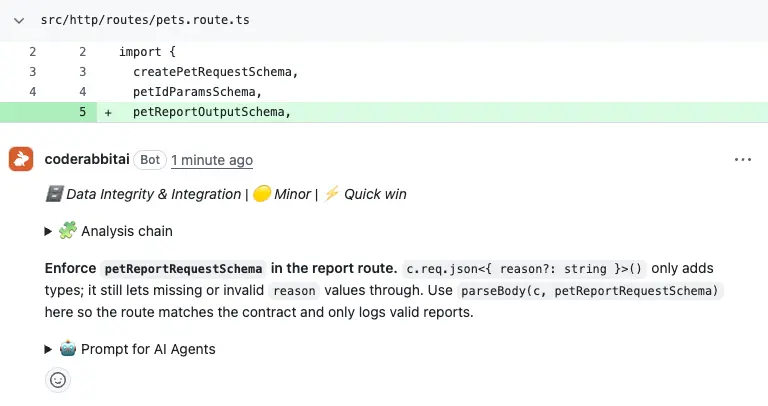
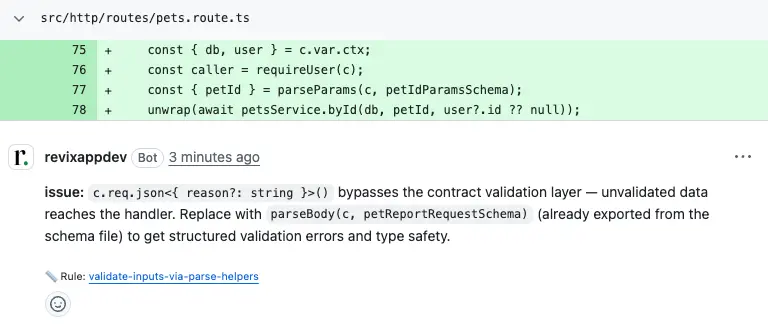
On PR #1, both tools flagged an unvalidated request body. A handler typed it with c.req.json instead of validating it. Both gave the same fix. The full write-up is in one finding, two reviewers.
November 2026: one PR with six known problems
On November 27, 2026, we opened PR #8 on the same public repo. It adds one endpoint, GET /pets/:petId/similar, and we built it with six known problems. Three break the repo's own rules. Three are logic bugs. Then both tools reviewed it. It is one small PR, not a benchmark.
The repo has no CodeRabbit rule file. There is no .coderabbit.yaml and no guidelines file, so CodeRabbit ran on its defaults. Revix builds its rules from the repo. The repo has under 10 stars, so CodeRabbit needs a manual trigger. We commented @coderabbitai review right after we opened the PR.
| Known problem | Revix | CodeRabbit |
|---|---|---|
| Missing pet returns 500, not 404 | Found, rule linked | Found |
| Business logic inside the route | Found, rule linked | Not flagged |
| Query params not validated | Found, rule linked | Found |
| Pagination offset skips page 1 | Found | Found |
| Ranking runs after pagination | Found | Found |
| Source pet counted in the total | Found | Found |
Revix found all six. CodeRabbit found five.
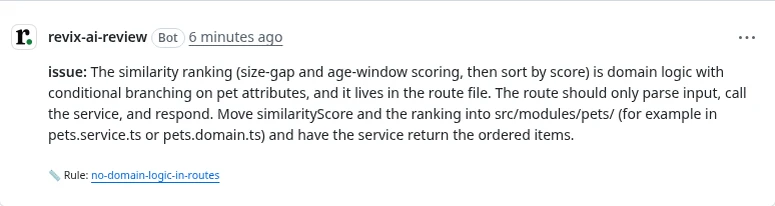
The one CodeRabbit did not flag is a rule problem. The similarity scoring and ranking live inside the route file. The repo has a rule, no-domain-logic-in-routes, that says a route should only parse input, call the service, and respond. Revix flagged it, named the rule, and said to move the scoring into the pets module. Greptile, Sourcery, and Cubic also reviewed this PR, and none of them flagged it.
Both tools caught the two pagination bugs:
- The offset is
page * perPage, but pages start at 1. So page 1 skips the first results. Both said to use(page - 1) * perPage. - The source pet matches its own filter. It is counted in the total, then removed from the page. Both said to exclude it in the query.

They also agreed on three more:
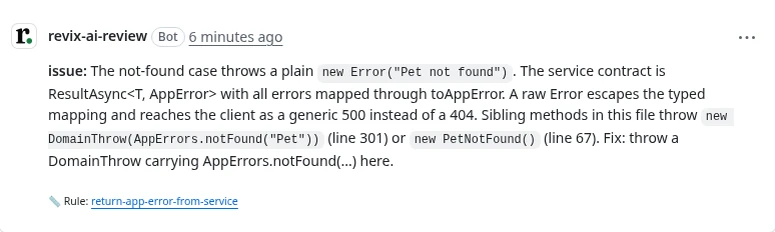
- A missing pet throws a plain
Error, so the API returns 500 instead of 404. Revix linked the rulereturn-app-error-from-serviceand pointed to theDomainThrowpattern the same file already uses. CodeRabbit said to use the existing domain-error mechanism. - The
pageandperPagevalues are read by hand, so negative values get through. Revix linked the rulevalidate-inputs-via-parse-helpersand said to useparseQuery. CodeRabbit said to validate them with a query schema. - Ranking runs after pagination, so it only reorders one page. Both said to score before paginating.
Revix on the missing-pet bug:
CodeRabbit on the same bug:
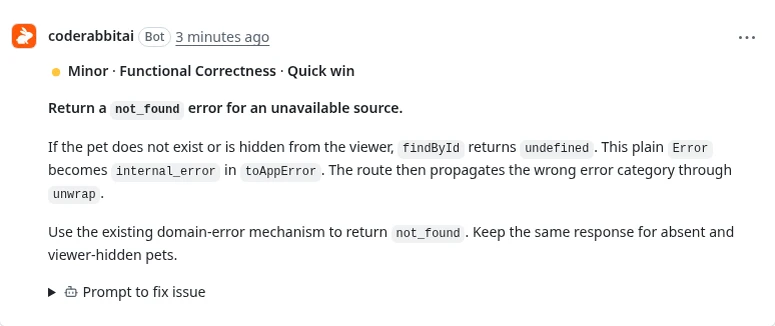
Revix also asked for tests for the new endpoint. It listed what to cover: paging, the excluded source pet, and the score order. CodeRabbit tags each comment with a severity and an effort label, and adds a prompt you can paste into a coding agent.
Revix posted all seven comments 67 seconds after the PR opened. CodeRabbit posted its review about 4 minutes after open, after our manual trigger on its free open-source tier. Paid-plan timing may differ. For more tools on other PRs, see the full tool list.
What we learned about setup
If you test on a small public repo, expect some friction with CodeRabbit's free open-source tier:
- Under 10 stars, CodeRabbit waits for a manual trigger. Its docs say to select Trigger review or comment
@coderabbitai review. - On PR #2, we closed the PR before the run finished. The review stopped with "Pull request is closed".
- Free open-source reviews have an hourly limit. PR #4 got a rate-limit notice.
- On PR #8, we commented
@coderabbitai reviewright after opening. Its review arrived about 4 minutes later.
We first ran this same diff on PR #7. We closed it and ran it again on PR #8 after a Revix update. Revix reviewed PRs #1 to #8 on its own, with no trigger.
Price and limits
Prices are in different currencies, so compare at your own seat count.
CodeRabbit plans
As of November 26, 2026, per user per month:
- Essentials: 24 USD billed annually, 30 USD monthly
- Team: 48 USD billed annually, 60 USD monthly
- Advanced: 72 USD billed annually, 90 USD monthly
- Enterprise: contact sales
The Free plan gives PR summaries only. Reviews on Free come through the VS Code extension and the CLI. New organizations get a 14-day Advanced trial.
Reviews per developer per hour are 5, 8, 10, and 12 from Essentials to Enterprise. Files per review are 150 on Essentials and 300 on the rest. Past the limit, you can turn on usage-based reviews at 0.25 USD per reviewed file, with a cap your admin sets. CodeRabbit bills only developers who create PRs.
Team adds test generation and finishing touches. Advanced adds continuous security monitoring.
Revix plans
- Open Source: free for public repositories
- Starter: 20 EUR per seat per month billed annually, 25 EUR monthly
- Pro: 40 EUR annually, 50 EUR monthly. It adds a priority queue for faster reviews and priority support. Slack, Jira, Linear and ClickUp context are on Starter and Pro.
- Enterprise: custom, with SOC 2 Type II and ISO 27001 certification
Every plan has a 14-day free trial with no credit card. Details are on the pricing page.
Git hosts
CodeRabbit supports:
- GitHub.com and GitHub Enterprise Server
- GitLab.com and GitLab self-managed
- Bitbucket Cloud and Bitbucket Data Center
- Azure DevOps
Revix supports:
- GitHub.com (GitHub code review)
- GitLab.com (GitLab code review)
- Bitbucket Cloud (Bitbucket code review)
Revix does not support GitHub Enterprise Server, GitLab Self-Managed, Bitbucket Data Center, or Azure DevOps yet. If you run one of those, CodeRabbit fits better today.
Pick CodeRabbit if
- You run GitHub Enterprise Server, GitLab self-managed, or Bitbucket Data Center.
- You are on Azure DevOps.
- You want reviews in your IDE or CLI before you push.
- You need self-hosting (Enterprise, 500+ seats) or a SaaS region your company picks.
- You want security checks, test generation, or finishing touches in the same tool.
- You want a USD contract or cloud marketplace billing on Enterprise.
Pick Revix if
- You want rules built from your own repo, without writing a rulebook first.
- You want each comment to name the rule it applies.
- You use GitHub.com, GitLab.com, or Bitbucket Cloud.
- You want EUR pricing and a trial with no credit card.
- You need a vendor that is SOC 2 Type II and ISO 27001 certified, on Enterprise.
- You want Jira, Slack, Linear, or ClickUp context on Starter and Pro.
For how repo-aware review differs from diff-based review, read repo-aware vs diff-based AI code review. For public repos, see free AI code review for open source.
Try both in two weeks
- Check Git host fit first. If a tool does not support your host, stop there.
- Start both trials on the same repo.
- Pick 10 real pull requests and let both review them.
- Count the comments your team acts on, for each tool.
- Note which comments are noise, and ask your seniors which tool they would miss.
What we checked, and when
On November 26 and 27, 2026, we checked:
- CodeRabbit pricing page
- CodeRabbit plans docs
- CodeRabbit platforms docs
- Revix pricing and AI code review pages
- Test PRs #1 and #8, plus PRs #2 to #7 in the same repo
Re-check prices on the vendor pages before you buy. More tools are on our list of AI code review tools, and the earlier CodeRabbit comparison has the July test in full.
See an error? Email team@revix.ai.
Frequently asked questions
Keep reading
- CodeRabbit alternatives: 6 tools comparedCompare 6 CodeRabbit alternatives for AI code review. See who each one fits, where CodeRabbit still wins, and prices checked November 2026.
- Best AI code review tools: 9 tools comparedCompare 9 AI code review tools by Git host and price. See how 5 reviewed the same public PR. Prices checked October 2026. By Revix.