CodeRabbit alternatives: 6 tools compared
Compare 6 CodeRabbit alternatives for AI code review. See who each one fits, where CodeRabbit still wins, and prices checked October 2026.


Updated October 26, 2026. We corrected Greptile's Pro pricing. On October 9 we added a short summary of one public test PR. On October 8 we turned this page into a list of six alternatives. We re-checked CodeRabbit, Cubic, Cursor Bugbot, Graphite, Greptile, and Revix against their own docs and pricing pages.
Disclosure: Revix makes an AI code review product, and Revix is one of the tools on this page. This is a comparison written by a vendor. Tools are listed in alphabetical order. The order is not a ranking.
We compared six CodeRabbit alternatives and competitors. Each one fits a different team:
- Cubic: GitHub teams that want custom agents and quieter comments
- Cursor Bugbot: teams already working in Cursor
- Graphite Agent: teams on stacked pull requests
- Greptile: teams that want a graph of the whole repo and runtime checks
- Qodo: organizations buying a governance suite
- Revix: teams that want review rules derived from their own code
We make Revix. It builds review rules from your code when you connect it, without waiting on review history.
Keep CodeRabbit if you need its Git host coverage, IDE and CLI review, or security tools. The snapshot table below compares all seven.
Side-by-side snapshot
| CodeRabbit | Cubic | Cursor Bugbot | Graphite Agent | Greptile | Qodo | Revix | |
|---|---|---|---|---|---|---|---|
| Core bet | Broad PR coverage + summaries + IDE/CLI | Custom agents, low noise | Review tied to Cursor and its agents | Stacked PR workflow + AI | Graph index of the repo | Governance + agentic review + IDE/CLI | Standards derived from the repo |
| Repo context | Medium to strong (multi-repo 1/5/10/20 by plan) | Strong (repo navigation claim) | PR diff, incremental by default | Stack-aware | Strong (graph) | Strong (context engine, cross-repo) | Strong (patterns and rules from repo) |
| Standards | Guideline files (AGENTS.md, CLAUDE.md, .cursorrules) + learnings + config | Custom agents / rules library | Team rules, BUGBOT.md, learned rules | Product settings | Custom rules + learns from reactions | Rule Miner + AGENTS.md + manual | Auto-extracted, editable rules |
| Git hosts | GitHub incl. Enterprise Server, GitLab incl. self-managed, Bitbucket Cloud and Data Center, Azure DevOps | GitHub only | GitHub, GitLab, Bitbucket incl. Data Center, Azure DevOps Services | GitHub + Graphite | GitHub, GitLab.com, Bitbucket Cloud; GHES, GitLab Self-Managed, Bitbucket Data Center, Gitea on Enterprise | GitHub, GitLab, Bitbucket, Azure DevOps, Gerrit | GitHub.com, GitLab.com, Bitbucket Cloud |
| Notable extra | Linters/SAST, pre-merge checks, finishing touches | IDE + local CLI review | Fix in Cursor, Autofix via Cloud Agents | Stacking + merge queue | TREX runtime validation, self-host | IDE/CLI/agents, on-prem | Conventional comments, Jira context |
| Ballpark paid start | Essentials $24/dev annual | Check cubic.dev | Usage-based, check cursor.com | Bundled with Graphite | $1/credit, no seat fees | Credit packs, check qodo.ai | €20 / €40 per seat annually |
Prices move. Confirm on each vendor's pricing page before you buy.
Try Revix against your own repo: revix.ai.
What CodeRabbit is good at
CodeRabbit's edge is breadth: many Git hosts and many review tools in one product.
- Hosts: as of October 2026, CodeRabbit's docs list GitHub.com, GitHub Enterprise Server, GitLab.com, GitLab self-managed, Bitbucket Cloud, Bitbucket Data Center, and Azure DevOps
- Where it reviews: pull requests (with a summary and inline comments), the IDE, and the CLI
- Standards: learnings from your replies, a
.coderabbit.yamlconfig, and guideline files such asAGENTS.mdandCLAUDE.md, which it auto-detects - Extras: linters and SAST, pre-merge checks, finishing touches (such as unit tests and merge conflict resolution), and post-merge actions
- Enterprise: self-hosting (for 500+ seats), EU SaaS deployment, SSO, and audit logs
- Install base: 17K customers across 6M repositories, per its homepage on October 8, 2026
Pricing as of October 2026, from coderabbit.ai/pricing, per developer per month:
- Essentials: $24 billed annually ($30 monthly)
- Team: $48 billed annually ($60 monthly)
- Advanced: $72 billed annually
- Enterprise: custom
Essentials and Team are the new names for Pro and Pro Plus. You pay only for developers who open pull requests. Reviews past the hourly limits cost $0.25 per file, up to a cap you set. Every plan has a 14-day trial with no card, and public repositories are free.
Why teams look for CodeRabbit alternatives
- Comment volume: authors stop reading, so teams turn the reviewer off.
- Written standards: someone still has to write guideline files or teach it through replies. Some teams want rules derived from the code on day one.
- Plan-capped context: multi-repo analysis covers 1, 5, 10, or 20 repositories by plan.
- Workflow fit: teams in Cursor or on stacked pull requests may want review in that loop.
- Price shape: some teams want usage billing, credits, or EUR invoices.
The 6 CodeRabbit alternatives
How we compared
We compared each option on these criteria, using vendor docs and pricing pages checked on October 8, 2026 (Qodo on October 7, 2026, and Greptile pricing on October 26, 2026). Pilot each tool on your own repos before you trust any table.
| Criterion | What we mean |
|---|---|
| Repo context | Does review use more than the diff? |
| Standards | How do team conventions get into the review? |
| Comment quality | Severity, actionability, noise control |
| Git hosts | GitHub, GitLab, Bitbucket, Azure DevOps, and whether cloud or self-hosted editions are covered |
| Pricing shape | Seats, credits, usage, free OSS, trial |
| Best fit | The team situation where it wins |
Cubic
Best for: GitHub teams that want low-noise review and custom agents for standards.
Hosts: GitHub only, per Cubic's docs as of October 2026.
Where Cubic wins
- Custom agents hold your team rules
- Learns from feedback to cut noise, and can auto-resolve fixed threads
- IDE and local CLI review
Where CodeRabbit still wins
- GitLab, Bitbucket, and Azure DevOps support
- Guideline files auto-detected, plus linters and SAST
- Enterprise self-hosting and EU SaaS deployment
Cursor Bugbot
Best for: teams already working in Cursor that want PR review, fixes, and agents in one loop.
Hosts: as of October 2026, Bugbot's docs list GitHub (including Enterprise Server), GitLab (including self-hosted), Bitbucket (including Data Center), and Azure DevOps Services.
Pricing: usage-based since May 2026. Rates are on Cursor's pricing page.
Where Bugbot wins
- Fix in Cursor,
/review-bugbotbefore you push, and Autofix through Cloud Agents - Rules in
.cursor/BUGBOT.mdscoped by folder, plus learned rules - Effort levels to trade review cost against depth
Where CodeRabbit still wins
- Review in any IDE and from the CLI, not tied to one editor
- Linters and SAST, pre-merge checks, and finishing touches
- A published per-developer price
Graphite Agent
Best for: teams already on Graphite's stacked PR workflow.
Hosts: GitHub, through your connected GitHub organizations.
Where Graphite Agent wins
- Native understanding of stacked diffs
- Review inside the stacking and merge-queue workflow
Where CodeRabbit still wins
- Standalone review for teams that do not stack
- GitLab, Bitbucket, and Azure DevOps support
- IDE and CLI review
Greptile
Best for: teams that want a graph of the whole repository behind every review, plus runtime checks on the PR.
Hosts: as of October 2026, Greptile's docs list GitHub, GitLab.com, Bitbucket Cloud, and Cursor Origin (beta) on all plans. GitHub Enterprise Server, GitLab Self-Managed, Bitbucket Data Center, and Gitea need Enterprise.
Pricing as of October 2026, from greptile.com/pricing:
- Starter: free for one active developer, 50 credits/month
- Pro: $1 per credit, no seat fees. You buy credits as you need them, and they are shared across the whole org
- Credits per review: 1 base, 3 Plus, 10 Apex
- Enterprise: custom
Where Greptile wins
- Graph index of the whole repo for cross-file and out-of-diff findings
- TREX runs your code and attaches logs, screenshots, and traces to the PR
- Self-hosting on Enterprise
Where CodeRabbit still wins
- Azure DevOps, which Greptile does not list
- IDE and CLI review, linters and SAST
- A flat per-developer price with no credit math
More detail: Greptile alternatives.
Qodo
Best for: organizations that want agentic review plus governance across many repos and hosts.
Hosts: as of October 2026, Qodo's docs list GitHub (including Enterprise Server), GitLab cloud and self-managed, Bitbucket Cloud and Data Center, Azure DevOps, and Gerrit.
Pricing: Pro Team uses pooled credits. Rates are on qodo.ai/pricing.
Where Qodo wins
- Rule Miner builds rules from accepted review comments, and Qodo imports
AGENTS.mdandCLAUDE.md - Cross-repo context and multi-repo governance
- Gerrit support and on-prem or air-gapped deployment
Where CodeRabbit still wins
- A simple per-developer plan ladder instead of credit packs
- A free plan for public repositories
- Linters and SAST, pre-merge checks, and finishing touches
More detail: Qodo alternatives.
Revix
Best for: teams that want every PR reviewed to a senior engineer's standard, with rules derived from the repository itself.
Revix reads your repository when you connect it and turns the patterns it finds into review rules. Every pull request is reviewed against those rules.
Hosts: Revix supports GitHub.com, GitLab.com, and Bitbucket Cloud. Self-hosted editions (GitHub Enterprise Server, GitLab Self-Managed, Bitbucket Data Center) and Azure DevOps are not supported yet.
Pricing: €20 Starter and €40 Pro per seat per month, billed annually, with a 14-day trial and no card required. Public repositories are free on the Open Source plan. Full Revix plans are on the pricing page.
Where Revix wins
- Rules come from your repo when you connect it, with no guideline files to write first. You can edit, add, or disable any rule.
- Rules are re-checked after merge. Revix also adds rules for your stack and libraries.
- Bitbucket Cloud teams get the same review path as GitHub and GitLab teams.
- EUR pricing and a simple trial for EU buyers.
Where CodeRabbit still wins
- GitHub Enterprise Server, GitLab self-managed, Bitbucket Data Center, and Azure DevOps
- IDE and CLI review, linters and SAST, and Enterprise self-hosting
- A larger install base and longer track record
Revix pages for each host: GitHub, GitLab, and Bitbucket.
Two tests on real PRs
One finding, two reviewers
In July 2026, CodeRabbit and Revix flagged the same bug on one pull request, with the same suggested fix. A handler typed its request body with c.req.json<{ reason?: string }>() instead of validating it.
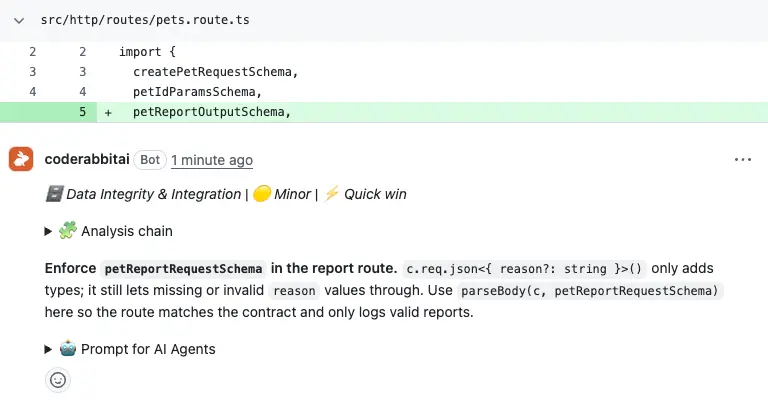
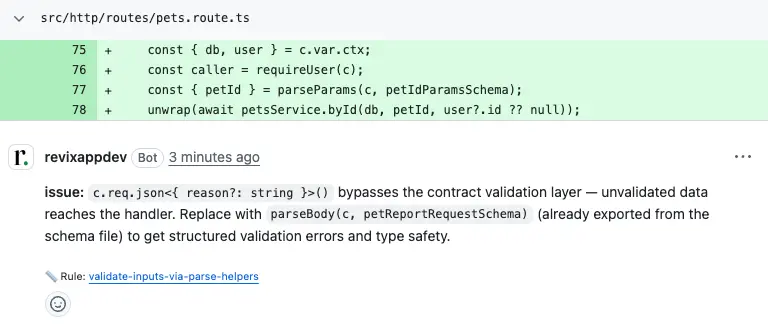
The two comments differ in three ways:
- The tag. Revix opens with
issue:, a Conventional Comments label. CodeRabbit uses its own category, severity, and effort line, which carries more information but is a vocabulary to learn. - The repo. Revix points to
parseBody, a helper the schema file already exports. - The rule. Revix links
validate-inputs-via-parse-helpers, a rule it derived from this codebase. CodeRabbit applies standards your team or agents wrote down, in guideline files or learnings.
Both comments get the line fixed. This is the repo-aware side of the split, applied to one comment.
A second test PR
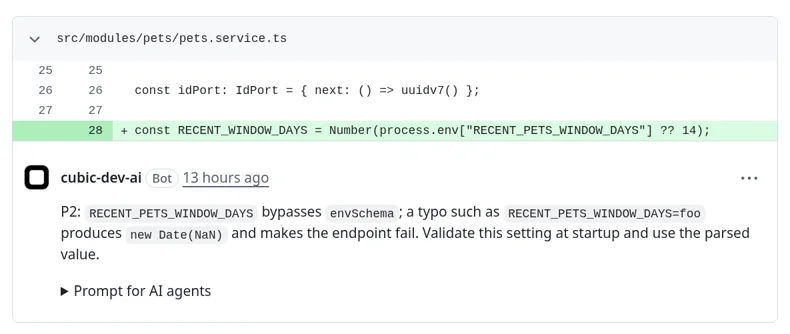
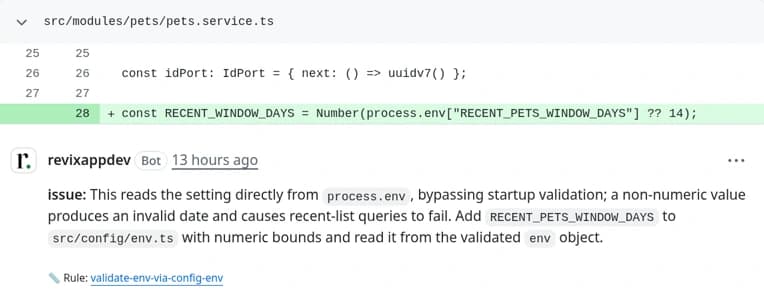
On October 8, 2026, we ran Cubic, Graphite, Greptile, and Revix on one small public test PR with two planted issues, including the same parse-helper rule as the July comments above. Cubic, Greptile, and Revix caught both, and Graphite caught one. Only Revix linked the team rule each comment broke on this PR. CodeRabbit did not review this PR, so use the July comments above for a CodeRabbit comparison. It is one small test, not a benchmark.
Cubic and then Revix on the env issue:
Full results, timings, and screenshots: Greptile alternatives. Every comment is on the public test PR.
Free and open source CodeRabbit alternatives
None of these seven tools is open source. These are the free and open source paths we know of:
- CodeRabbit: free reviews for public repositories
- Revix: free reviews for public repositories on the Open Source plan. See free AI code review for open source.
- Greptile: free for one active developer, or for qualified non-commercial projects with an OSI-approved license, on application
- PR-Agent: MIT-licensed and community-maintained, started at Qodo. You host it yourself. We have not tested it.
A free hosted plan still sends your code to the vendor. If that is your concern, self-host PR-Agent.
How to choose in two weeks
- Pick two or three active repos, the same for every tool.
- Install one tool per repo in week one, so comments do not collide.
- Track comments accepted, comments ignored, and time to first useful review.
- After week two, ask your seniors: "Would you miss this if we turned it off?"
- Keep CodeRabbit if its accepted comments stay high and you need its hosts or tools.
- Try Cubic or Revix if authors ignore half the thread, or your standards only show up after someone writes them down.
- Try Greptile if out-of-diff context is the pain.
- Try Bugbot if your team already works in Cursor.
- Try Graphite Agent if you already ship with stacked PRs.
- Try Qodo if you need governance across many hosts.
For diff vs whole-repo review, see Repo-Aware AI Code Review vs. Diff-Based Review.
When CodeRabbit is still the right pick
Stay on CodeRabbit if you need:
- GitHub Enterprise Server, GitLab self-managed, Bitbucket Data Center, or Azure DevOps
- IDE and CLI review beside pull request review
- Linters, SAST, and pre-merge checks from one vendor
- Self-hosting or EU SaaS deployment
Switch when rules from your code, quieter comments, editor-native review, stacked pull requests, or a different pricing shape matter more than that breadth.
Bottom line
CodeRabbit covers more hosts and tools in one product than most reviewers here. Each alternative wins on a narrower job. Match the tool to your bottleneck, then measure accepted comments for two weeks. To widen the shortlist, see all tools compared.
See what Revix flags on your next pull request: revix.ai. Every team starts with a 14-day free trial, no card required.
Frequently asked questions
Keep reading
- Greptile alternatives: 6 tools, plus free and open source optionsGreptile alternatives: 6 AI code review tools compared by fit, tradeoffs, and price (checked October 2026). Includes free and open source options.
- Qodo alternatives: 6 tools comparedCompare 6 Qodo alternatives for AI code review. See who each one fits, where Qodo still wins, and prices checked October 2026.