Greptile alternatives: 6 tools, plus free and open source options
Compare 6 Greptile alternatives for AI code review. See who each one fits, the tradeoffs, and prices checked October 2026. Includes free and open source options.


Updated October 7, 2026. We corrected Greptile's Bitbucket support, added Cursor Bugbot, and re-checked Greptile and Bugbot against their own docs and pricing pages.
Disclosure: Revix makes an AI code review product, and Revix is one of the tools on this page. This is a comparison written by a vendor. Tools are listed in alphabetical order. The order is not a ranking.
We compared six Greptile alternatives and competitors for AI code review. Each one fits a different team:
- CodeRabbit: broad pull request (PR) coverage, summaries, and lots of settings
- Cubic: GitHub teams that want quiet review and custom agents
- Cursor Bugbot: teams already working in Cursor
- Graphite Agent: teams on stacked PRs
- Qodo: governance across many repos
- Revix: every PR reviewed against rules mined from your own repo
We make Revix. It builds review rules from your code when you connect it, without waiting on review history.
Keep Greptile if you need out-of-diff context, TREX runtime validation, self-hosting, or Enterprise-only hosts such as Bitbucket Data Center, GitLab Self-Managed, and Gitea.
Side-by-side snapshot
| Greptile | CodeRabbit | Cubic | Cursor Bugbot | Graphite Agent | Qodo | Revix | |
|---|---|---|---|---|---|---|---|
| Core bet | Graph index of the repo | Broad PR coverage + summaries | Custom agents, low noise | Review tied to Cursor and its agents | Stacked PR workflow + AI | Governance + integrity | Standards mined from the repo |
| Repo context | Strong (graph) | Medium to strong (plan-dependent) | Strong (repo navigation claim) | PR diff, incremental by default | Stack-aware | Strong (context engine) | Strong (patterns and rules from repo) |
| Standards | Custom rules + learns from reactions | Config + learnings | Custom agents / rules library | Team rules, BUGBOT.md, learned rules | Product settings | Rules / skills governance | Auto-extracted, editable rules |
| Git hosts | GitHub, GitLab.com, Bitbucket Cloud; GitHub Enterprise Server, GitLab Self-Managed, Bitbucket Data Center, Gitea on Enterprise | Broad (check current plan) | GitHub only | GitHub, GitLab, Bitbucket incl. Data Center, Azure DevOps | GitHub + Graphite | Broad enterprise story | GitHub.com, GitLab.com, Bitbucket Cloud |
| Notable extra | TREX runtime validation, self-host | Summaries, large ecosystem | IDE + background agents | Fix in Cursor, Autofix via Cloud Agents | Stacking + merge queue | Testing / integrity suite | Conventional comments, Jira context |
| Ballpark paid start | $30/seat + credits | See CodeRabbit comparison | Check cubic.dev | Usage-based, check cursor.com | Bundled with Graphite | Check qodo.ai | €20 / €40 per seat annually |
Prices move. Confirm on each vendor's pricing page before you buy.
See what Revix flags on your next pull request at revix.ai.
What Greptile is good at
Greptile reviews each PR with a graph of your repo, so it can find bugs outside the diff. It wins when you want:
- Full-repo context for cross-file and out-of-diff findings
- TREX runtime validation, which runs your code and attaches logs, screenshots, and traces to the PR
- Broad Git host coverage: GitHub, GitLab.com, and Bitbucket Cloud on all plans, plus GitHub Enterprise Server, GitLab Self-Managed, Bitbucket Data Center, and Gitea on Enterprise
- Self-hosting, including air-gapped setups
- Custom rules that you write, plus learning from your 👍/👎 reactions and replies over time
Pricing (as of October 2026, from greptile.com/pricing):
- Starter is free for one active developer (50 credits/month).
- Pro is $30 per seat per month with 50 credits per seat, and extra credits are $1.
- A base review costs 1 credit, a Plus review 3, and an Apex review 10.
- Enterprise is custom, including self-host.
- Qualified non-commercial open source projects get Greptile for free.
Why teams look for Greptile alternatives
- Standards: full context helps, but without explicit rules you still get comments that don't match how your repo already works.
- Noise: teams turn tools off when authors stop reading the comments.
- Pricing shape: with $30/seat plus credits, the bill depends on review depth. Some teams want flat seats, usage billing, or EUR invoices.
- Ramp-up: Greptile's docs say it stops commenting on things you don't care about after 2 to 3 weeks of reactions. Some teams want rules on day one.
- Editor fit: teams already in Cursor may want review that hands findings straight to Cursor's agents.
The 6 Greptile alternatives
How we compared
We compared each tool on the six criteria below, as of September 2026. We re-checked Greptile and Cursor Bugbot facts, and Cubic's Git hosts, against vendor docs and pricing pages in October 2026.
| Criterion | What we mean |
|---|---|
| Repo context | Does review use more than the diff? |
| Standards | How do team conventions get into the review? |
| Comment quality | Severity, actionability, noise control |
| Git hosts | GitHub, GitLab, Bitbucket, and whether cloud or self-hosted editions are covered |
| Pricing shape | Seats, credits, usage, free OSS, trial |
| Best fit | The team situation where it wins |
CodeRabbit
Best for: teams that want broad PR coverage, summaries, and a mature GitHub App with lots of settings.
Where CodeRabbit wins
- A large ecosystem of docs, plugins, and examples
- PR summaries and walkthroughs
- Hosts beyond GitHub (check your plan)
Where Greptile still wins
- Full-repo graph indexing
- TREX runtime validation
- Self-hosting, including air-gapped setups
Pick CodeRabbit when you want a well-known default and will spend time tuning it. For Revix vs CodeRabbit on rules and config, see CodeRabbit Alternatives.
Cubic
Best for: GitHub teams that want low-noise review and custom agents for standards.
Where Cubic wins
- Team rules written as custom agents, which suits teams already writing Cursor rules
- A focus on cutting false positives, plus IDE and background-agent workflows
Where Greptile still wins
- GitLab and Bitbucket. As of October 2026, Cubic's docs list GitHub only.
- Full-repo graph and TREX runtime validation
- Self-host enterprise options
Pick Cubic when you are on GitHub and want quieter comments.
Cursor Bugbot
Best for: teams already working in Cursor that want PR review, fixes, and agents in one loop.
Where Bugbot wins
- Fix in Cursor,
/review-bugbotbefore you push, and Autofix through Cloud Agents - Rules from
.cursor/BUGBOT.mdfiles, team rules, and learned rules - Azure DevOps, plus GitHub, GitLab, and Bitbucket including Data Center, per Bugbot's docs (October 2026)
Where Greptile still wins
- A full-repo graph. Bugbot reviews PR diffs, incrementally by default.
- TREX runtime validation and self-hosting
- A published per-seat price. Bugbot moved to usage-based billing in May 2026 (rates on Cursor's pricing page).
Pick Bugbot when your team already works in Cursor, or you need Azure DevOps.
Graphite Agent
Best for: teams already on Graphite's stacked PR workflow.
Where Graphite Agent wins
- Native understanding of stacked diffs
- Review built into stacking and the merge queue
Where Greptile still wins
- Standalone review for teams that do not stack
- Full-repo context
Pick Graphite Agent when stacking is already how you ship.
Qodo
Best for: organizations that want code integrity, testing, and governance across many repos. Qodo was formerly CodiumAI.
Where Qodo wins
- Multi-repo governance and a rules lifecycle
- Testing and code integrity alongside PR review
- Azure DevOps and Gerrit support
Where Greptile still wins
- Simpler setup for full-repo PR review
- TREX runtime validation
- Per-seat pricing that is easy to read
Pick Qodo when you are buying a governance suite. For the full breakdown, see Qodo alternatives.
Revix
Best for: teams that want senior-standard review on every PR, with rules mined from the repo itself.
Revix extracts patterns from your codebase and turns them into review rules. The rules update as the repo changes, and every PR is reviewed against them.
Where Revix wins
- Rules apply from the first PR, and you can edit, add, or disable them.
- Comments with a Conventional Comments label and a short fix
- EUR pricing: €20 Starter and €40 Pro per seat per month billed annually, with a 14-day trial and no card required. Full plans are on the pricing page.
Where Greptile still wins
- Wider Git hosts. Revix supports GitHub.com, GitLab.com, and Bitbucket Cloud, but not self-hosted editions or Azure DevOps yet.
- Graph index and TREX runtime validation
- Self-host and enterprise packaging
Pick Revix when review does not match how your team already writes code. Pick Greptile when you miss out-of-diff bugs or need a host Revix does not support.
One test PR, five reviewers
Cubic, Greptile, Revix, and Sourcery caught both planted issues. Graphite caught the env issue. Among the four that caught both, the tools differed on this PR in speed and in whether the comment linked the team's written rule. Only Revix linked it. This is one small test, not a benchmark, so run your own pilot on your own repos.
On October 8, 2026, we opened one small PR in a public Hono and TypeScript test repo. Each planted issue breaks a rule the repo already has in writing:
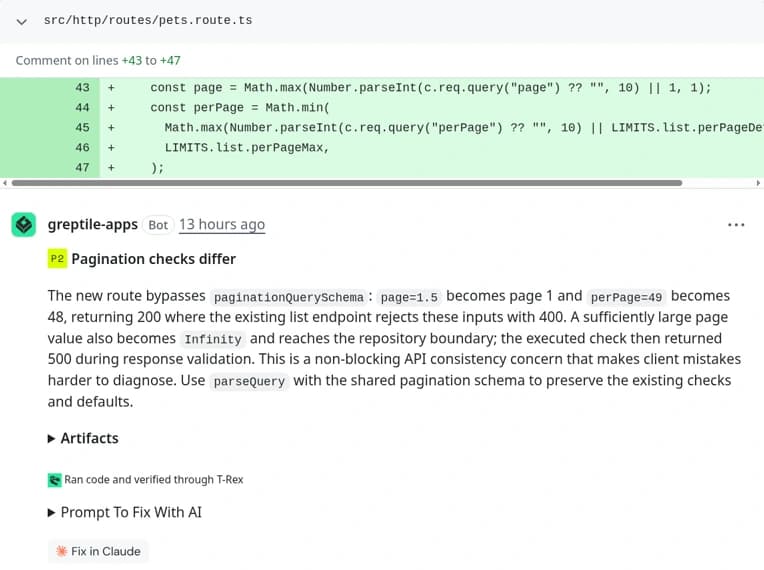
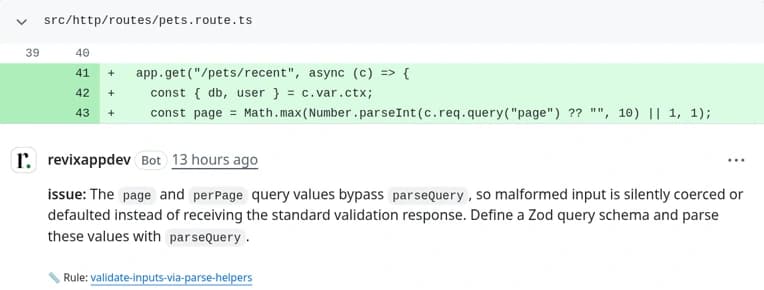
- Pagination issue. The route hand-parses
pageandperPageinstead of using theparseQueryhelper. - Env issue. The service reads the
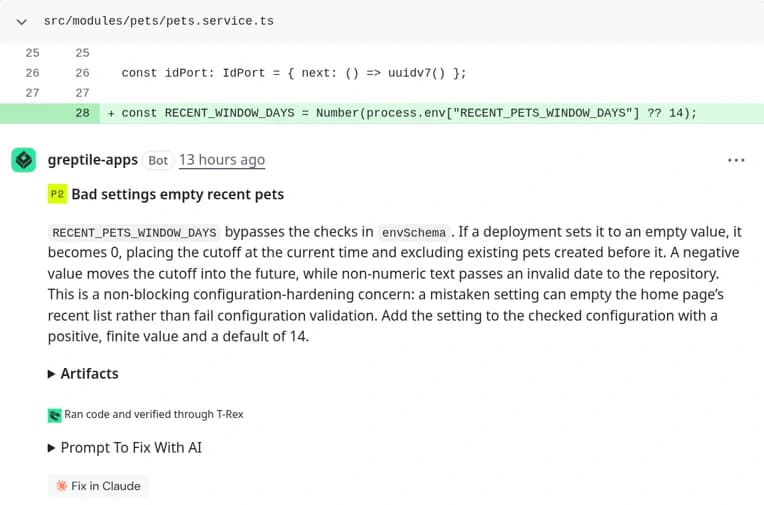
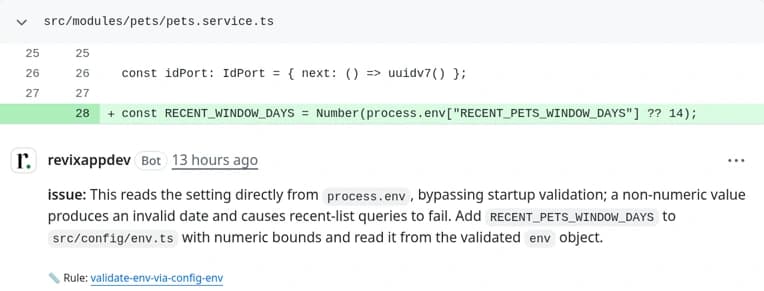
RECENT_PETS_WINDOW_DAYSsetting straight fromprocess.envinstead of the validated env insrc/config/env.ts.
We added Sourcery as a fifth tool. Every tool ran on default settings, and every comment is on the public test PR.
| Tool | First comment | Pagination issue | Env issue | Cites the team's written rule |
|---|---|---|---|---|
| Cubic | ~4 min | Yes (P2) | Yes (P2) | No |
| Graphite | n/a (added the next day) | No | Yes | No |
| Greptile | ~12 min | Yes (P2) | Yes (P2) | No |
| Revix | ~1 min | Yes | Yes | Yes, linked |
| Sourcery | ~3 min | Yes (Medium) | Yes (Medium) | No |
Times run from opening the PR to each tool's first comment, from one run each. We switched Graphite on the next day, so its time is not comparable. It did not comment on the pagination code. Greptile and Sourcery each left one extra comment, about missing tests and the README. We did not run CodeRabbit, Cursor Bugbot, or Qodo against this PR.
Greptile and then Revix on the pagination issue:
And on the env issue:
How the comments read
Visible comment length ran from 27 words (Cubic) to 132 words (Graphite). Each extra has a benefit and a cost for the person reviewing.
| Tool | Words per comment (visible) | Format | Extras |
|---|---|---|---|
| Cubic | 27 to 37 | P2 rank | Collapsed prompt for AI agents |
| Graphite | 132 (one comment) | No label | Code block plus one-click suggested change |
| Greptile | 84 to 100 | P2 rank | Links to artifacts from running the code |
| Revix | 38 to 42 | Conventional comment label (issue:) | Link to the team rule |
| Sourcery | 64 to 84 | Medium rank | Collapsed prompt for AI agents |
Word counts cover the visible text on the two planted issues, not collapsed sections.
- Greptile's artifacts prove it ran the code. They sit behind links and bring a comment to about 390 words with collapsed parts. Without clicking, you only see the top paragraph.
- Graphite's one-click fix is handy. Here it parsed the value inside the service, against the repo's written rule to use
src/config/env.ts, so a human still has to catch it. - Cubic's and Sourcery's prompts for AI agents help if you hand fixes to a coding agent. Sourcery's prompt repeats the whole comment, so the thread doubles in size.
- Severity ranks (P2, Medium) help you sort many findings. Here, every tool that ranks gave both issues the same rank. Revix uses conventional comment labels (
issue:,suggestion:,nitpick:) instead, which show the kind of comment, not a severity rank. - Revix's rule links. Each comment is short, has a label, and links the team rule it broke. There is no one-click fix, run artifacts, or prompt for AI agents, so you apply the fix yourself.
Free and open source Greptile alternatives
Every tool on this page is commercial. The free and open source paths:
- Greptile: Starter is free for one active developer. It is also free for qualified non-commercial projects with an OSI-approved license, on application.
- Revix: public repos get free reviews on a limited Open Source plan. See free AI code review for open source.
- Qodo: as of September 2026, open source teams can apply for Qodo for Open Source. There is no permanent free tier for private repos.
- PR-Agent: MIT-licensed and community-maintained, started at Qodo. You host it yourself. We have not tested it, so it is not in the comparison.
A free hosted plan still sends your code to the vendor. If that matters, self-host PR-Agent or Greptile.
How to choose in two weeks
- Pick two or three active repos, and use the same ones for every tool.
- Run one tool per repo in week one, so comments do not collide.
- Track comments left, accepted, and ignored, plus time to first useful review and setup minutes.
- After week two, ask your seniors: "Would you miss this if we turned it off?"
Keep Greptile if its accepted comments are clearly higher and the team still reads them. Try Revix or Cubic if authors ignore half the thread, Bugbot if you work in Cursor, and Graphite Agent if you ship with stacked PRs. For how diff-based and full-repo review differ, see Repo-Aware AI Code Review vs. Diff-Based Review.
When Greptile is still the right pick
Stay on Greptile if:
- Out-of-diff context is your biggest pain
- You need TREX runtime validation or self-hosting
- You run Bitbucket Data Center, GitLab Self-Managed, or Gitea (Greptile Enterprise)
Bottom line
Greptile is a strong pick for repo-context review, and it covers more Git hosts than many buyers expect. Match the tool to your bottleneck, then measure accepted comments for two weeks.
See what Revix flags on your next PR at revix.ai, with a 14-day free trial and no card required.
Frequently asked questions
Keep reading
- Qodo alternatives: 6 tools comparedCompare 6 Qodo alternatives for AI code review. See who each one fits, where Qodo still wins, and prices checked October 2026.
- CodeRabbit alternatives: 6 tools comparedCompare 6 CodeRabbit alternatives for AI code review. See who each one fits, where CodeRabbit still wins, and prices checked October 2026.