Is AI Code Review the New Standard, or Just Hype?
AI code review catches convention drift and speeds up first-pass review, but it isn't a replacement for human judgment on architecture and design decisions.

Every few months a new tool claims it's going to replace code review. Every few months, teams who actually tried it land somewhere more boring: it caught a bunch of stuff worth catching, and it never touched the decisions that actually mattered.
Good at one job, useless at another. The "standard vs. hype" debate goes in circles because it treats AI code review as one thing instead of two. If you want the mechanics first, start with what AI code review is and how it works.
What it has actually earned
A senior reviewer's time was never spent entirely on judgment calls. Most of it went to the same handful of mechanical things: a missed null check, a pattern that drifted from how the rest of the repo does it, a retry loop without backoff. None of that requires taste, just attention applied to every diff, every time. It burns a reviewer out three PRs before lunch, and it is the shape of work a model is suited for.
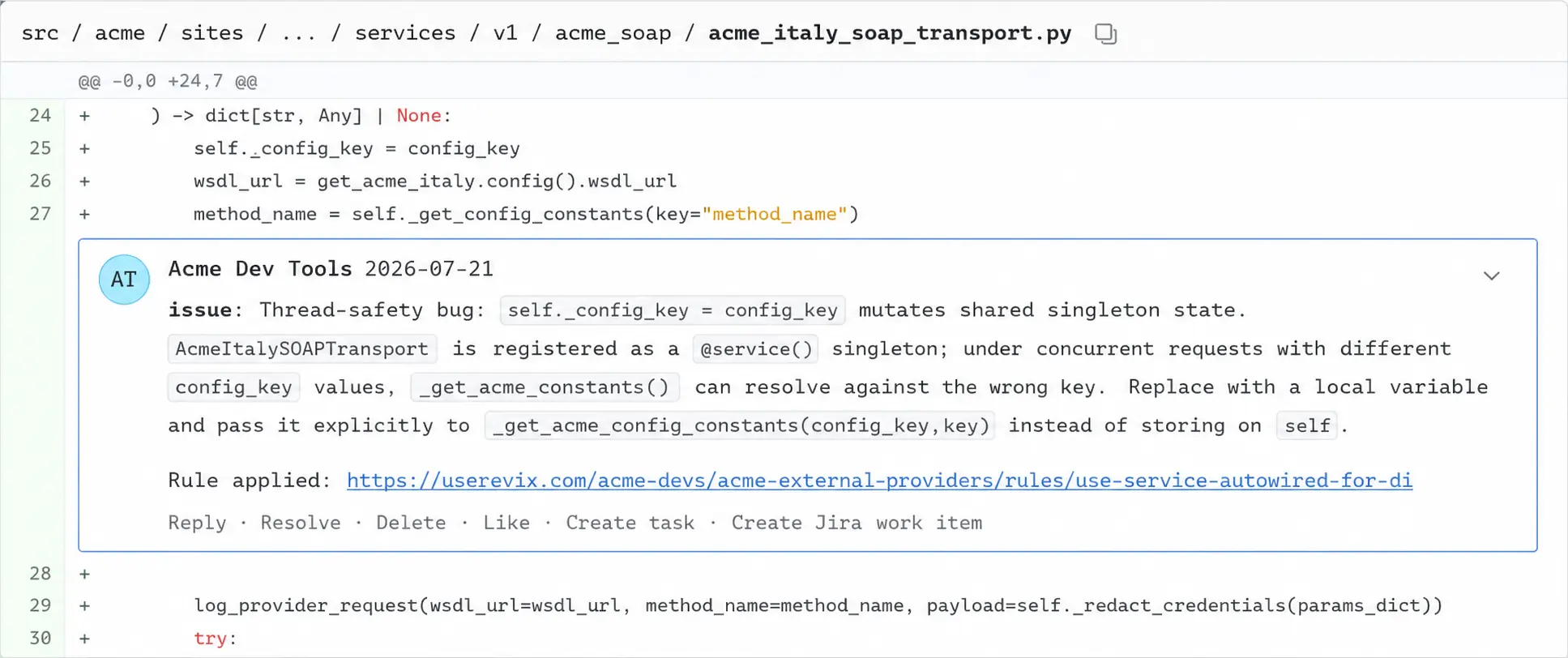
That's a thread-safety bug, caught because it broke a rule the team had already settled on, and posted with a link back to the rule instead of a vague objection. Precise, sourced, waiting in the PR before a human opens it.
The real risk with AI review is noise: a bot commenting on everything until people stop reading it. That's why precision matters more than coverage, and it's measurable. We tracked it in What 200 Pull Requests Taught Us About AI Code Review: a 70% signal rate across review comments, meaning most of what got flagged was something the team actually acted on, not a nitpick.
Precision is a writing problem too. Every comment carries a tag and a severity, the four-part shape that tells an author whether to stop or keep going.
Where the judgment still lives
None of that answers whether this should be a new service or belong in the one that already exists, or whether an abstraction holds up in six months instead of just solving today's ticket.
Is this correct, or is this right for us?
AI code review, even the repo-aware kind we cover in Repo-Aware AI Code Review vs. Diff-Based Review, answers the first question. The second depends on context no repository holds: what the team is optimizing for this quarter, what got deprioritized last sprint. That's a different kind of question, not a limitation a bigger model fixes.
What it actually replaces
AI code review takes back the 20 minutes a senior reviewer spends catching things a machine should have caught first. Those 20 minutes were never judgment, and the call on whether something belongs in the codebase is still theirs.
That's the role we built Revix AI for: a fast, precise first pass that clears convention drift and mechanical catches before a reviewer opens the PR, so their attention goes to the calls only they can make.
Try it against your own repo: revix.ai. Every team starts with a 14 day free trial, no card required.
Keep reading
- What Is AI Code Review and How Does It Work?How AI code review works stage by stage, what it reliably catches, where it fails, and the one difference between tools that decides what yours can find.
- Repo-Aware AI Code Review vs. Diff-Based ReviewMost AI code reviewers only read the pull request. The ones that read the whole repo catch what a diff alone can't, like broken conventions, duplicate abstractions, and architectural drift.